

 United States
What Is EV Betting?
A winning bet can be a bad bet. A losing bet can be a good one. EV measures the price—not the result.
When a sportsbook pays more than your fair odds say it should, the difference is your edge.
Reviewed by WagerWise · Updated September 2, 2026
EV Judges the Price
EV stands for expected value. It asks one question: are the sportsbook's odds better than the outcome deserves?
If the answer is yes, the bet is positive EV—even if it loses tonight. The goal is not to predict every winner. It is to keep taking prices that should return more than they cost.
- Positive EV (+EV)
- The sportsbook is paying more than your fair odds say it should.
- Negative EV (-EV)
- The return is too short for the risk you are taking.
- Fair odds
- Your best estimate of the true price after removing vig and checking the wider market.
- Value bet
- A wager offered at better odds than your fair-price estimate.
The Formula Is the Easy Part
You need three inputs: win probability, profit if it wins and the stake you lose if it does not.
EV = (win probability × profit if win) − (loss probability × stake)A positive answer means the price is in your favor. A negative answer means the sportsbook is charging too much. The hard part comes first: deciding what fair really is.
Run the Numbers
A sportsbook offers +110 on a $100 wager. You price the same outcome at -125, or a 55.56% chance of winning.
That does not mean you expect to win $16.67 tonight. It means the price is worth an average $16.67 per $100 staked if your fair odds are right.
| Input | Math | Value |
|---|---|---|
| Win contribution | 55.56% × $110 profit | +$61.11 |
| Loss contribution | 44.44% × $100 stake | −$44.44 |
| Expected value | $61.11 − $44.44 | +$16.67 |
| EV percentage | $16.67 ÷ $100 | +16.67% |
How to Find EV and True Odds
Pinnacle is an input. It is not the truth.
True odds are not sitting in a database waiting to be found. Before the event starts, they are always an estimate.
Pinnacle, Smarkets and Polymarket can be strong references when the market is liquid, recent and identical to the sportsbook selection. They become weak evidence when liquidity disappears, spreads widen or the markets do not match.
A stronger method uses a variation of the wisdom of crowds: compare several current prices, remove the market margin and reduce the impact of stale or outlying quotes.
-
Match the exact market Event, period, selection, line and settlement rules must agree. Over 47.5 is not Over 48. A moneyline is not a point spread, and a player prop must match the same player and statistic.
-
Strip out the vig Use every outcome in the matching market to remove the sportsbook margin. On an exchange, account for spread, commission and the money available at that price.
-
Build the crowd Combine current fair prices. Give credible markets more influence and stop one strange quote from hijacking the estimate.
-
Set the fair price Suppose the crowd prices an NFL game total, Over 47.5, at +100. That is an estimated 50% fair probability—not a promise.
-
Take the gap If a sportsbook offers +115, the price is 7.5% above the +100 fair estimate. That is the modeled edge.
Historical MLB price record
One Bet. Two Fair-Price Answers.
DraftKings offered +101 on Christian Encarnacion-Strand over 1.5 total bases. The broader market put fair odds at -102, creating a 1.7% edge. Pinnacle's no-vig price sat at +108 and rejected the bet.
 August 30, 2026
- Game
- Athletics at Baltimore Orioles
- Selection
- Christian Encarnacion-Strand over 1.5
- Market
- Player total bases
- DraftKings odds
- +101
- Broader fair odds
- -102
- Expected value
- +1.7% EV
What the comparison showed
- Pinnacle no-vig
- +108A Pinnacle-only check showed no edge at the DraftKings price.
- Final DraftKings record
- -101The last archived price, recorded 23 seconds before the listed start.
- Game result
- 0 total basesThe player went 0-for-4 and the wager lost.
That disagreement matters. Sharp books are useful inputs, not verdicts. DraftKings later moved from +101 to -101, toward the broader fair price. The bet lost. One result does not erase the value in the price.
The final recorded DraftKings price is an archived observation, not an official closing line. View the official MLB game record.
Move Before the Price Does
Doing the calculation by hand works once. It does not work across thousands of sportsbook markets that keep moving.
WagerWise compares supported US sportsbook prices, ranks the estimated edges and keeps every opportunity tied to its event, market, line and live price. Confirm the number at the sportsbook before you act.
See current US +EV bets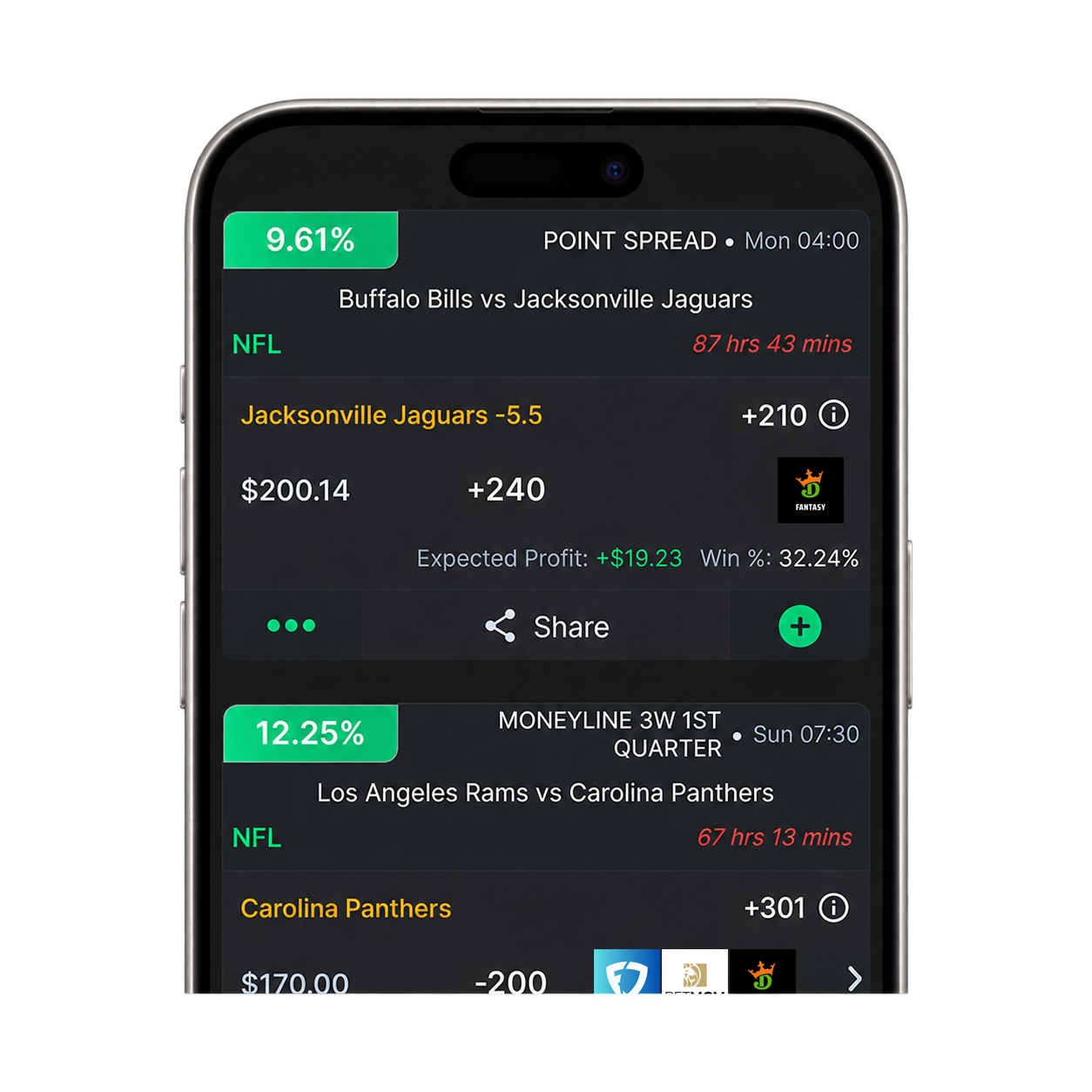
A Good Bet Can Still Lose
The DraftKings example above lost. That result did not travel back in time and change the price. Positive EV describes the decision, not the next score.
EV lives across a sample. Keep stakes small enough to survive a normal losing run. Flat staking is simple. Kelly staking can size bets around bankroll and edge, but it becomes dangerous when the fair probability is too confident.
EV Is Not Arbitrage
| Measure | EV betting | Arbitrage betting |
|---|---|---|
| Core idea | Take a price above estimated fair value. | Cover every listed outcome at prices that create a calculated return. |
| Short-term result | Any individual wager can win or lose. | The calculation targets a return across all accepted legs. |
| Main risk | The fair-price estimate can be wrong. | Prices can move, stakes can be limited and one leg can be rejected. |
| Typical workflow | One value wager plus long-term tracking. | Two or more coordinated wagers placed before prices change. |
Where EV Bettors Get Burned
- Believing one sharp bookPinnacle is useful. It is still one price from one market.
- Comparing a different contractA -3 spread is not -3.5. Player, period, line and settlement rules must match.
- Betting a stale edgeThe opportunity is gone when the sportsbook moves the price.
- Confusing edge with certaintyA +EV long shot can lose. A bad favorite can win.
- Letting stakes outrun the bankrollA bigger bet increases the damage. It does not improve the edge.
- Calling it proven after ten betsShort samples are noise-heavy. Judge the prices and the process over time.
Is EV Betting Legal in the US?
EV betting is a way to evaluate sportsbook prices, not a separate wager type. Online sports betting availability and operator rules vary by state.
Use only sportsbooks permitted where you are located, follow their terms and confirm your eligibility before wagering. WagerWise does not make an operator legal or available in a state.
Straight Answers
What does +EV mean in betting?
+EV means positive expected value. The sportsbook price is better than your fair-price estimate, producing a positive modeled return over repeated wagers.
Can a positive EV bet lose?
Yes. EV describes the estimated long-run average, not the result of one wager. Losing bets and losing streaks remain possible.
Are value betting and EV betting the same?
They are commonly used for the same idea: taking sportsbook odds that are higher than the estimated fair probability implies.
Can I calculate EV with American odds?
Yes. Convert the sportsbook odds and fair odds into probabilities or decimal prices, then apply the expected value formula. The WagerWise EV calculator handles the conversion automatically.
How much positive EV is enough?
There is no universal cutoff. A large EV estimate based on stale or weak fair odds can be less useful than a smaller edge supported by exact, current market data.
Does WagerWise guarantee profitable bets?
No. WagerWise displays modeled price edges. Prices can move, markets can be mismatched and the fair-price estimate can be wrong.
Price First. Result Second.
Run one price through the calculator. When you are ready to scan the market, open the US positive EV board.